Returning Home After the Spokane County Wildfires: Smoke, Soot, Odor, and Indoor Air Quality Help
After the recent wildfires in Spokane County, many homeowners are beginning the difficult process of returning home, assessing their property, and figuring out what needs to happen next. Even when evacuation notices are lifted and roads begin reopening, the recovery process is not always simple.
Some homes may have visible fire damage. Others may look mostly untouched from the outside but still have smoke odor, soot, ash, contaminated surfaces, moisture from firefighting efforts, or indoor air quality concerns. For families returning after a wildfire evacuation, it is important to slow down, look carefully, and avoid assuming the home is safe just because there are no visible flames or structural damage.
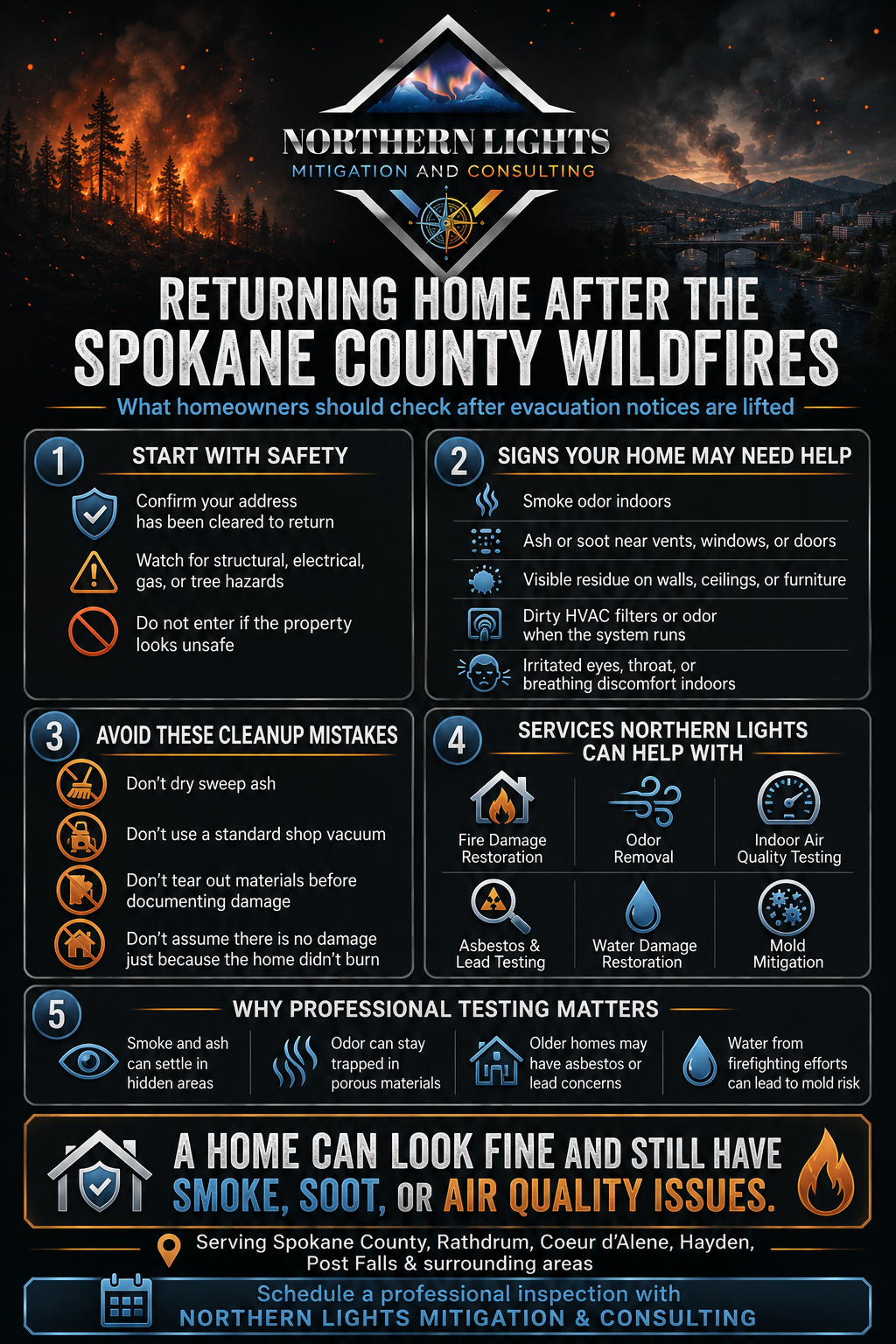
Northern Lights Mitigation & Consulting is here to help homeowners and property owners in Spokane County, North Idaho, and the surrounding region navigate the next steps after wildfire exposure. Our team provides fire damage restoration, odor removal, indoor air quality testing, asbestos and lead testing, water damage restoration, and mold mitigation services for homes and businesses affected by fire, smoke, ash, or water intrusion.
Start With Safety Before Entering or Cleaning
Before going inside your home, make sure your specific area and address have been cleared by emergency officials. If there are active hazards, damaged electrical components, downed utility lines, gas smells, structural damage, unstable trees, or visible flare-ups, do not enter the property.
When returning after a wildfire, look around the exterior first. Check for damage to the roof, siding, windows, doors, vents, gutters, decks, fencing, electrical equipment, HVAC equipment, and nearby vegetation. Smoke, ash, and heat can affect more than the obvious burn area.
If something looks unsafe, pause and contact the proper emergency, utility, or restoration professionals before disturbing the area.
A Home Can Have Smoke Damage Even Without Direct Fire Damage
One of the biggest misconceptions after a wildfire is that a home is only damaged if it burned. That is not always the case.
Smoke and ash can enter a home through vents, gaps, attic spaces, crawl spaces, doors, windows, HVAC systems, and small openings around the structure. Even if the home is still standing and appears intact, smoke residue may settle on walls, ceilings, floors, furniture, insulation, ductwork, and personal belongings.
This can create lingering odors, surface contamination, and potential indoor air quality issues. For homeowners who are sensitive to smoke, have children in the home, or have family members with asthma or respiratory concerns, this should be taken seriously.
Northern Lights can help evaluate whether smoke odor, soot, ash, or airborne particles may be affecting the inside of the home.
Common Signs Your Home May Need Smoke or Fire Damage Cleanup
Not all fire-related damage is obvious. Some signs are immediate, while others become more noticeable after the home has been closed up for a few hours or days.
Watch for signs such as:
Persistent smoke or campfire-like odor indoors
Soot or ash near windows, doors, vents, baseboards, or attic access
Discoloration on walls, ceilings, blinds, or soft surfaces
Dusty residue that returns after light cleaning
Irritated eyes, throat, or nose while inside the home
HVAC filters that are dark, dirty, or smoke-stained
Odor that worsens when the furnace, AC, or fan runs
Ash around exterior doors, patios, walkways, or window tracks
Smoke odor in furniture, carpet, clothing, bedding, or curtains
If these signs are present, a professional inspection can help determine whether the issue is surface-level cleaning, odor removal, air filtration, deeper restoration, or indoor air quality testing.
Do Not Dry Sweep Ash or Use a Standard Shop Vacuum
Ash and soot should be handled carefully. Dry sweeping can stir particles into the air, and a standard shop vacuum or household vacuum without proper HEPA filtration can push fine particles back into the home.
Instead, lightly affected hard surfaces may need careful wet cleaning methods. Soft materials, upholstery, carpets, curtains, and insulation may need a different approach depending on the level of smoke exposure. In some cases, professional cleaning, filtration, odor treatment, or removal may be needed.
This is especially important when ash may include material from burned homes, vehicles, sheds, plastics, treated wood, roofing, insulation, paints, chemicals, or other building materials. Wildfire ash near structures can contain more than ordinary wood ash.
Why Indoor Air Quality Testing Matters After Wildfire Smoke Exposure
After a wildfire, homeowners often ask, “Is the air inside my home safe?”
That question can be difficult to answer by smell alone. A home may smell smoky but still need targeted cleaning and filtration. Another home may not smell severe but could still have particles or contamination in certain areas.
Indoor air quality testing can help provide more clarity. Testing may be especially helpful when:
Smoke odor is persistent
Children, elderly family members, or sensitive individuals live in the home
The HVAC system ran during smoke exposure
Ash or soot is visible inside
The home was near a burned structure
Odor returns after basic cleaning
There are concerns about contaminated surfaces or airborne particles
The family wants documentation before moving fully back in
Northern Lights Mitigation & Consulting provides indoor air quality testing to help homeowners make more informed decisions after wildfire smoke exposure.
Smoke Odor Removal Is More Than Covering Up the Smell

Smoke odor can be stubborn because it can settle into porous materials. Carpets, upholstery, clothing, curtains, drywall, insulation, wood, and contents can all hold odor. Simply spraying fragrance or using household air fresheners may temporarily mask the smell, but it does not address the source.
Professional odor removal focuses on identifying where the odor is coming from and treating the affected areas correctly. Depending on the situation, this may involve cleaning, filtration, air scrubbing, containment, deodorization, or recommendations for material removal when odor has deeply penetrated certain surfaces.
For Spokane County homeowners returning after wildfire evacuations, odor should not be ignored. Persistent smoke smell can be a sign that residue remains inside the home.
Asbestos and Lead Testing After Fire Damage
Older homes and buildings may contain asbestos or lead-based paint. Fire, heat, smoke, demolition, debris removal, or damaged building materials can create a hazard when those materials are disturbed.
This is one of the reasons homeowners should be careful before tearing out drywall, flooring, siding, insulation, ceiling materials, roofing, or other damaged materials. Cutting, sanding, breaking, scraping, or removing materials without testing can release hazardous particles.
Northern Lights offers asbestos and lead testing for property owners who need to understand what may be present before cleanup, removal, repairs, or restoration work begins.
This can be especially important for homes with fire-damaged materials, smoke-damaged interiors, older building components, or planned demolition and reconstruction.
Water Damage and Mold Concerns After Firefighting Efforts
Wildfire recovery is not only about smoke and soot. Some properties may also have water damage from firefighting efforts, broken pipes, damaged roofs, compromised windows, or sprinkler systems.
Water can enter wall cavities, crawl spaces, flooring, insulation, cabinets, and subfloor materials. If it is not dried correctly, moisture can lead to swelling, material damage, odors, and possible mold concerns.
Northern Lights can help identify and address water damage after a fire event. Our services include water damage restoration, water mitigation, mold mitigation, and moisture inspection support for homes and businesses dealing with secondary damage after a wildfire.
What Homeowners Should Document for Insurance
Before cleaning, removing materials, or discarding belongings, document the damage as thoroughly as possible. Take photos and videos of the exterior, interior, personal belongings, visible ash, soot, smoke staining, damaged materials, and any areas with water intrusion.
It is also helpful to write down:
When you evacuated
When you were cleared to return
What you noticed when you arrived
Whether the home has smoke odor
Whether ash or soot is visible indoors
Whether utilities were interrupted
Whether the HVAC system ran during smoke exposure
Whether there is water damage from firefighting or weather exposure
What items or rooms appear affected
Contact your insurance company early and ask what documentation they need before cleanup begins. A professional restoration inspection can also help create a clearer record of affected areas and recommended next steps.
How Northern Lights Can Help Spokane County Homeowners
Northern Lights Mitigation & Consulting provides practical post-fire support for homeowners who are returning after the Spokane County wildfires and trying to determine what needs to happen next.
Our services can help with:
Smoke and soot cleanup guidance
Smoke odor removal
Indoor air quality testing
Asbestos and lead testing
Water damage restoration
Mold mitigation
Moisture inspections
Documentation support for affected areas
Whether your home has visible fire damage or simply does not feel right after smoke exposure, our team can help inspect the issue, identify potential concerns, and recommend a safe path forward.
Local Help After the Spokane County Wildfires
The days and weeks after a wildfire evacuation can feel overwhelming. Families are trying to return home, check on neighbors, contact insurance, clean up safely, and decide what can be saved. During that process, it helps to have a local mitigation and consulting team that understands the urgency and cares about the community.
Northern Lights Mitigation & Consulting serves homeowners and businesses throughout Spokane County, Rathdrum, Coeur d’Alene, Hayden, Post Falls, and the surrounding Inland Northwest region.
If your home has been affected by wildfire smoke, soot, ash, odor, water damage, or indoor air quality concerns, contact Northern Lights Mitigation & Consulting for a professional inspection and clear next steps.
Frequently Asked Questions About Returning Home After Wildfire Evacuation
-
Yes. Smoke and ash can enter through vents, windows, doors, attic spaces, crawl spaces, HVAC systems, and small openings around the home. A property can have smoke odor, soot, ash, or indoor air quality concerns even without direct flame damage.
-
Confirm your address has been cleared by emergency officials, inspect the outside for hazards, avoid entering if you see structural or utility concerns, document the damage, and contact your insurance company. If smoke, soot, ash, odor, or water damage is present, schedule a professional inspection.
-
Light ash may be cleaned carefully in some cases, but homeowners should avoid dry sweeping, stirring up dust, or using a standard shop vacuum. Ash from burned structures can contain hazardous materials, so professional guidance is recommended when there is significant ash, soot, or debris.
-
Smoke odor can settle into porous materials such as carpet, upholstery, drywall, insulation, clothing, curtains, and wood. If odor remains after airing out the home, the source may need professional cleaning, filtration, deodorization, or material-specific restoration.
-
Indoor air quality testing may be helpful if smoke odor is persistent, ash or soot is visible indoors, the HVAC system ran during heavy smoke, or sensitive individuals live in the home. Testing can help homeowners better understand the condition of the indoor environment.
-
Older homes may contain asbestos or lead-based materials. If fire, heat, smoke, or cleanup work may disturb building materials, testing should be considered before cutting, sanding, removing, or demolishing affected areas.
